Radiation can damage a robot’s electronics, sensors, cables, seals, and lubricants. A robot built for nuclear sites or space needs more than a thick outer shell; it needs a plan for which parts will fail first and how people will replace them.
- Radiation changes the design life of electronics and sensors.
- Shielding adds mass, cost, and limits to movement.
- Software, spare parts, and remote repair matter as much as hardware.
What radiation does to a robot
Ionizing radiation carries enough energy to change materials and electronic circuits. A high dose can cause permanent damage, while lower doses may create faults that appear only after repeated exposure.
That makes the robot’s working time hard to judge from a normal factory test. A motor may run correctly in a clean lab, yet a camera, memory chip, or power controller may fail after the robot has spent time near a radiation source.
Sensors face their own problems. Cameras can suffer image damage, cables can lose their protective layers, and seals can become less reliable when heat, radiation, and chemicals act together. The robot must keep moving after one part starts to weaken.
Why a shield is not enough
Shielding can reduce the radiation that reaches a component, but the shield adds weight and size. Extra mass raises the load on motors, joints, batteries, and transport systems.
A shield also needs gaps for cameras, joints, wheels, cooling, and communication links. Those openings can become weak points. Engineers may place sensitive parts farther from the radiation source, add local shielding around them, or use parts rated for a known dose range.
The design choice depends on the task. A stationary inspection robot can carry more shielding than a small machine that must climb stairs, pass through narrow spaces, or work at the end of a long arm.
The next designs will fail in sections
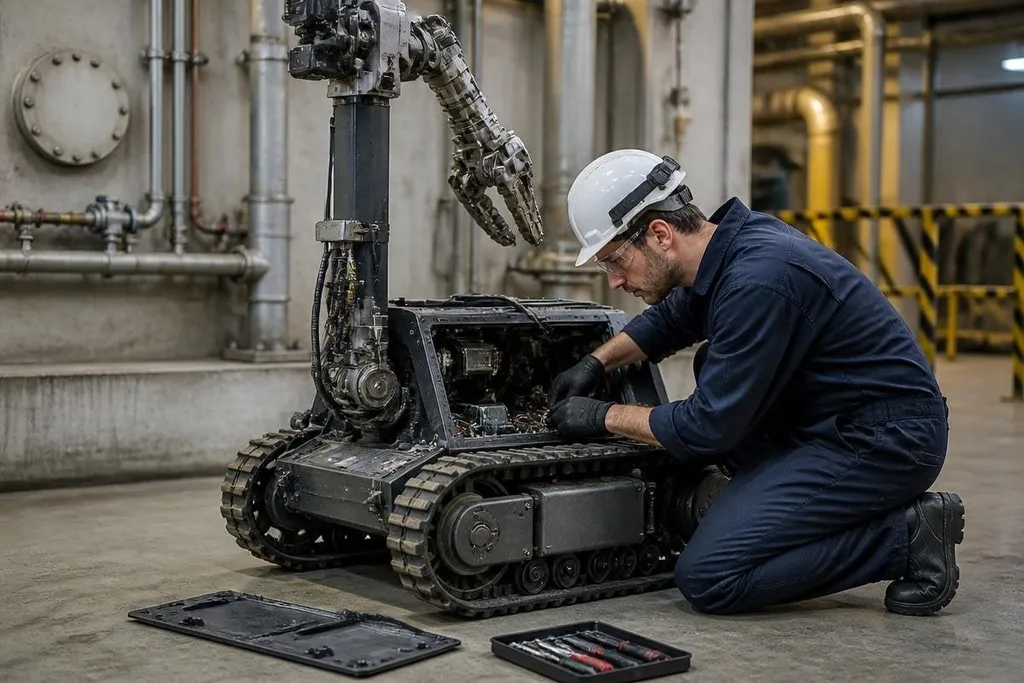
Radiation-resistant robots will be easier to keep working when their parts can be changed without sending the whole machine away. This may mean sealed electronics trays, replaceable camera units, separate motor controllers, and connectors that technicians can reach while wearing protective gear.
Redundancy helps too. A robot with two ways to measure position can keep operating after one sensor becomes unreliable. That does not remove the need for repair; it gives the operator time to move the robot to a safer place.
Software will watch for small changes in motor current, sensor noise, memory errors, and battery behavior. Those signals can help a control team decide when to stop a robot before a minor fault becomes a recovery problem.
Those warning signals matter when a report names the radiation dose, test time, robot model, and fault that followed. Use Robot24.com to check those details before the article turns to where these robots will work.
Where these robots will work
Nuclear plants, waste sites, research facilities, and space missions all present different radiation conditions. A robot for one site may not suit another because dose rate, heat, dust, access, and repair rules vary.
Remote operation will remain part of the design. Autonomy can help with repeated inspection tasks, but operators still need clear video, force feedback, status data, and a way to recover the machine when its route becomes blocked.
The open question is how much autonomy can survive when cameras degrade or communication becomes unreliable. A robot that can keep a safe position, report its condition, and return on command may be more useful than one that performs a harder task but cannot recover.
A buying and design checklist
Before choosing a radiation-resistant robot, check these points:
- Radiation limit: Ask for the tested dose, dose rate, and test conditions for every sensitive part.
- Failure plan: Find out which sensor or controller is expected to fail first and what the robot does then.
- Repair access: Check whether technicians can change damaged parts without replacing the full robot.
- Shielding cost: Measure the added mass, power use, size, and effect on the robot’s reach.
- Remote recovery: Confirm how operators will locate, stop, tow, or retrieve the robot after a fault.
- Data quality: Check how the system records dose, errors, sensor health, and time spent in the work area.
I'd choose a robot with replaceable modules and clear failure reports over one that claims a tougher body without showing how the full system was tested.
The next useful milestone will be a published service record: which parts failed, after what exposure, and how long replacement took. Until those records exist, radiation resistance remains a design claim rather than a working life measured in the field.